Crisis Migration from Sri Lanka: How economic collapse fueled the 2022-2026 exodus to Western countries
The Perfect Storm: Anatomy of Sri Lanka's 2022 Economic Collapse Sri Lanka's 2022 economic collapse was not a single event but the culmination of a perfect storm, where years of mismanagement collided with catastrophic policy blunders and devastating external shocks. The crisis dismantled the soci...
The Perfect Storm: Anatomy of Sri Lanka's 2022 Economic Collapse
Sri Lanka's 2022 economic collapse was not a single event but the culmination of a perfect storm, where years of mismanagement collided with catastrophic policy blunders and devastating external shocks. The crisis dismantled the social contract, eroding the middle class and creating the powerful "push factors" that fueled a wave of crisis migration.
The foundation of the collapse was laid over decades of chronic budget deficits and a reliance on foreign commercial loans to finance public services and ambitious infrastructure projects. This created a precarious dependency on international capital markets and a steady flow of foreign currency.
This vulnerability was catastrophically exposed by a series of self-inflicted wounds. In 2019, the newly elected government enacted sweeping tax cuts, which gutted state revenue and severely hampered its ability to repay debt. This was followed by a sudden and disastrous ban on chemical fertilizers in 2021. The misguided push for organic farming decimated agricultural output, particularly in the vital tea and rice sectors, leading to food shortages and a sharp drop in export earnings.
As the government's reserves dwindled, external shocks delivered the final blows. The COVID-19 pandemic paralyzed the tourism industry, a critical source of foreign exchange, while the war in Ukraine caused global fuel and food prices to skyrocket. With no dollars left to pay for essential imports, the country ground to a halt.
For ordinary citizens, the consequences were dire and immediate:
- Endless queues for fuel and cooking gas, often lasting days.
- Daily power cuts stretching for over 12 hours.
- Hyperinflation that rendered savings worthless and made basic goods unaffordable.
- Critical shortages of medicine, food, and other essential supplies.
This collapse of daily life and the evaporation of future prospects transformed migration from a choice into a necessity for survival, driving thousands to seek stability and opportunity in Western nations.

The Exodus Begins: Who Left and Why
The 2022 economic collapse did not trigger a uniform flight from Sri Lanka; rather, it unleashed a multi-layered exodus that drained the nation of its human capital. The departure was not limited to a single demographic but represented a broad cross-section of a society pushed to its breaking point. This was a migration born not of ambition, but of necessity.
The first wave consisted of those with the means and globally recognized skills. This was the nation’s professional class: doctors, IT specialists, engineers, and academics. They watched as their life savings were obliterated by hyperinflation and their salaries became insufficient to cover basic living costs. For them, the decision was a calculated one—a flight from professional stagnation and a crumbling quality of life towards career stability and a secure future for their children in countries like Australia, Canada, and the United Kingdom.
The exodus, however, ran deeper than a simple “brain drain.” It included:
- The Skilled Workforce: Experienced technicians, hospitality managers, and tradespeople saw their industries decimated. With tourism at a standstill and local businesses failing, they sought opportunities in the Middle East and Europe, chasing the promise of stable employment and the ability to send remittances back to struggling families.
- The Middle Class: Perhaps the most significant group, middle-class families who formed the backbone of the economy began to leave. The grueling fuel queues, medicine shortages, and endless power cuts made daily life untenable. They sold properties and assets to fund visa applications, seeing migration as the only viable escape from a future of perpetual crisis.
- Youth and Students: Young Sri Lankans and recent graduates looked ahead and saw a horizon devoid of opportunity. They aggressively pursued student visas for Western nations, viewing higher education less as an academic pursuit and more as a direct pathway to permanent residency and a life unmarred by the instability that defined their home.
The unifying reason was the complete erosion of hope. The collapse was more than economic; it was a profound failure of governance that shattered citizens' faith in the state's ability to provide basic security. The exodus was a vote of no confidence, a desperate search for the stability that had vanished from their homeland.

Destination West: Navigating New Lives and Challenges
The journey from Sri Lanka's economic turmoil did not end upon arrival in the West. For the thousands who reached countries like Canada, Australia, and the United Kingdom, landing on foreign soil marked the beginning of a new, complex struggle. While they had escaped hyperinflation, fuel queues, and political instability, they now faced the daunting task of building a life from scratch in societies with vastly different economic and social landscapes.
The initial challenges were immense. Securing stable legal status—whether through skilled worker visas, student pathways, or asylum claims—was a slow and often stressful bureaucratic process. Financially, the shock was immediate. The high cost of living in Western cities quickly eroded what little savings they had managed to bring. The dream of stability was often overshadowed by the urgent pressure to find work, pay rent, and send crucial remittances back to family members still grappling with the crisis at home.
Many were highly skilled professionals—doctors, engineers, and IT specialists—who faced the frustrating reality of underemployment. Their qualifications were often not immediately recognized, forcing them into survival jobs far below their expertise. This professional setback was compounded by profound social isolation. Torn from tight-knit communities and support systems, they navigated loneliness and cultural differences while trying to form new connections. Their new life was a paradox: a safe harbor from the storm at home, but one that demanded immense resilience to navigate its own turbulent waters in the long and arduous pursuit of a stable future.

The Road Ahead: Long-Term Impacts and Projections (2024-2026)
As Sri Lanka navigates the fragile aftermath of its economic collapse, the period between 2024 and 2026 is projected to be defined by a persistent, though evolved, pattern of outward migration. The initial chaotic surge of departures seen in 2022-2023 will likely transition into a more sustained and calculated exodus of skilled professionals and middle-class families. The primary drivers will remain the same: a profound lack of confidence in the nation's economic recovery, political instability, and the search for long-term security for their children.
The most critical long-term impact for Sri Lanka is an accelerating brain drain. The continuous departure of doctors, engineers, IT specialists, and academics threatens to hollow out the very sectors essential for national rebuilding. This exodus of human capital creates a vicious cycle where the lack of skilled professionals impedes economic revival, further incentivizing others to leave. For Western host countries, this influx represents a gain of highly educated and motivated individuals who can fill critical labor shortages, though it may also strain asylum and immigration processing systems.
Looking towards 2026, the trajectory of this migration hinges directly on Sri Lanka's progress. A slow or stalled recovery will ensure that migration pathways to the West remain a popular and necessary option. The newly expanded diaspora will also play a crucial role, sending vital remittances back home while establishing networks that facilitate future migration. Ultimately, the 2022-2026 exodus will leave a lasting demographic imprint, reshaping Sri Lanka’s professional landscape and expanding its global diaspora for decades to come.

Related Articles

Australia - Schedule 3 Issues: Protecting Your Visa Status While Building Relationships
In the world of Australian immigration, "Schedule 3" is a term that strikes fear into the hearts of onshore applicants. For many Sri Lankans who travel to Australia on a student or visitor visa and subsequently fall in love with an Australian citizen or permanent resident, the transition to a Partn...
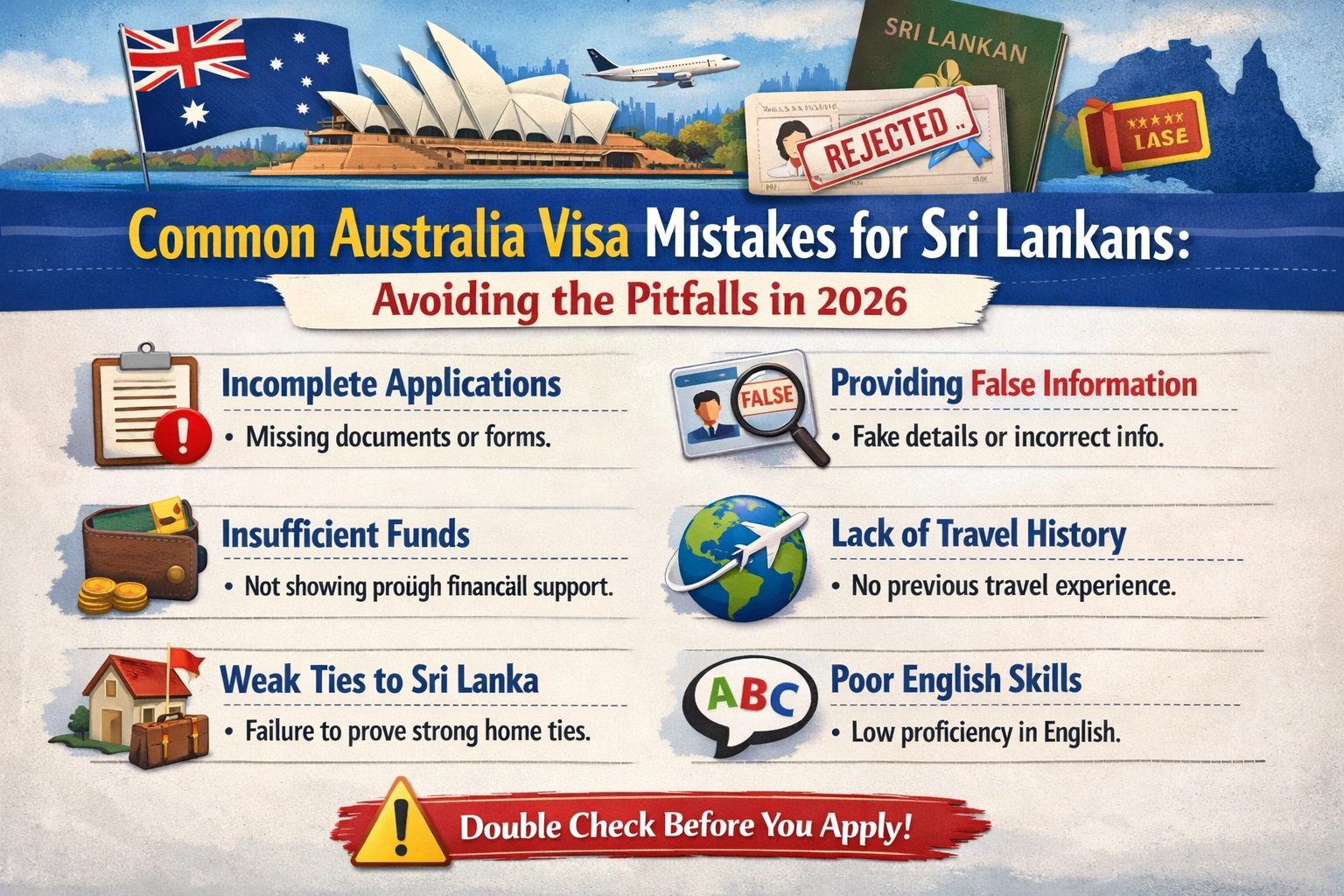
Common Australia Visa Mistakes for Sri Lankans: Avoiding the Pitfalls in 2026
The journey from Sri Lanka to Australia is paved with good intentions but often derailed by small, avoidable errors. In 2026, the Australian Department of Home Affairs (DoHA) has moved toward a "zero-tolerance" digital verification system. A single inconsistency in your employment dates or a "parke...
Australia Credential Recognition: Getting Your Sri Lankan Qualifications Assessed
One of the biggest hurdles for Sri Lankan professionals moving to Australia is "Credential Recognition." You may be a senior engineer in Colombo or a lead developer in Kandy, but to the Australian Department of Home Affairs, your skills don't exist until they are "validated" by an Australian assess...

Australia Partner Visa: The Path to Permanent Residency for Couples
For many Sri Lankans, the journey to Australia isn't just about a career—it's about reuniting with a loved one. Whether you have married an Australian citizen, are in a long-term de facto relationship, or are planning to wed your fiancé(e), the Australian Partner Visa is the specialized pathway des...