Skip to content
Have you ever meticulously prepared your university applications, secured that life-changing acceptance letter, only to feel a growing sense of dread about the F-1 visa interview? For many Sri Lankan students, this final step feels like the most unpredictable part of the journey. The paperwork seems endless, and the brief interview holds the power to validate years of hard work or bring it all to a sudden halt. The reality is that most visa denials for qualified students don't happen because of poor grades or a weak application. They happen because of small, avoidable mistakes in demonstrating non-immigrant intent or presenting financial documents. A consular officer has only a few minutes to assess your case, and a poorly explained answer about your post-graduation plans or confusing bank statements can unfortunately lead to a swift "214(b)" refusal. This guide is built to prevent that. We will show you precisely how to articulate your strong ties to Sri Lanka, what specific financial evidence carries the most weight, and how to structure your interview answers with confidence. You’ll get a clear breakdown of the most common errors we see and a step-by-step framework to help you walk into your appointment fully prepared.

1: Pre-Application Essentials & Your I-20 Form

You’ve done it. The acceptance letter from your dream U.S. university is in your hands. After the initial celebration, a new feeling sinks in: a wave of paperwork and unfamiliar acronyms. You’re holding the proof of your academic acceptance, but the path to the U.S. Embassy in Sri Lanka feels foggy. What is this I-20 document everyone talks about, and what do you do with it first?
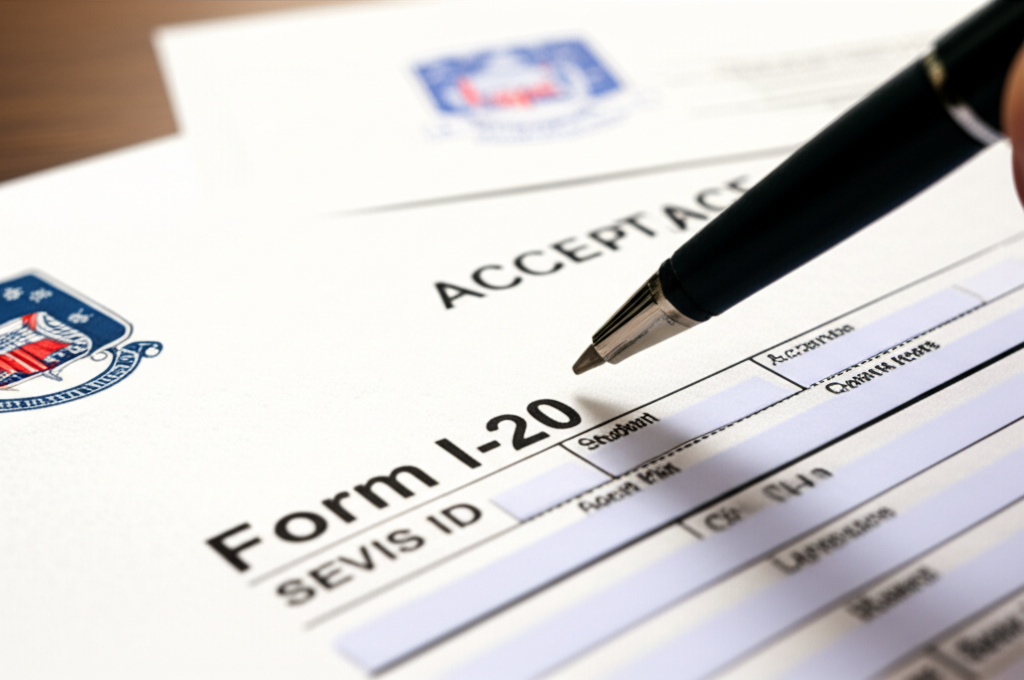
Close-up of the Form I-20, a crucial document for the F-1 student visa.
Think of your Form I-20, "Certificate of Eligibility for Nonimmigrant Student Status," as the foundation of your entire visa application. It is the official document issued by your SEVP-approved U.S. school that proves you are eligible to apply for an F-1 visa. Without it, you cannot move forward. This document contains your unique SEVIS ID number, typically starting with an 'N', found on the top left corner. This ID is your personal identifier within the U.S. immigration system for your entire academic journey.

The First Critical Step: Paying the I-901 SEVIS Fee

Once you have your I-20, your immediate next action is to pay the I-901 SEVIS fee. This is a mandatory US$350 payment to the U.S. Department of Homeland Security that funds the Student and Exchange Visitor Program. You must pay this fee before your visa interview; you cannot pay it at the embassy. The payment must be made online through the official portal, FMJfee.com. Common Mistake: Many students in Colombo and Kandy get their I-20 and, in their excitement, immediately try to book a visa interview slot or start the DS-160 form. They leave the SEVIS fee for later. A student we knew, let's call him Ramesh, waited until three days before his interview to pay. In his rush, he entered one digit of his SEVIS ID incorrectly. When he arrived at the embassy, the consular officer's system showed no record of his payment, causing an immediate and stressful complication that jeopardized his application. How to Avoid It: Pay your I-901 SEVIS fee the same day you receive your I-20. Treat these two things as a single task. Go to the official website, carefully enter your name exactly as it appears on your passport, and triple-check your SEVIS ID against the number on your I-20 form. Print the payment confirmation receipt. This simple, proactive step demonstrates you are organized and serious, setting a positive tone before you even speak to a consular officer.

2: Mastering the DS-160 Application Form

You’ve got your I-20, your acceptance letter is framed, and your dream of studying in the U.S. feels closer than ever. Then you open the DS-160 online application and a wave of anxiety hits. Page after page of questions, each one feeling like a potential trap. A single typo could delay your application, or worse, contribute to a denial. It’s a feeling I’ve seen countless students grapple with; the fear that one small mistake on this digital form could undo months of hard work.
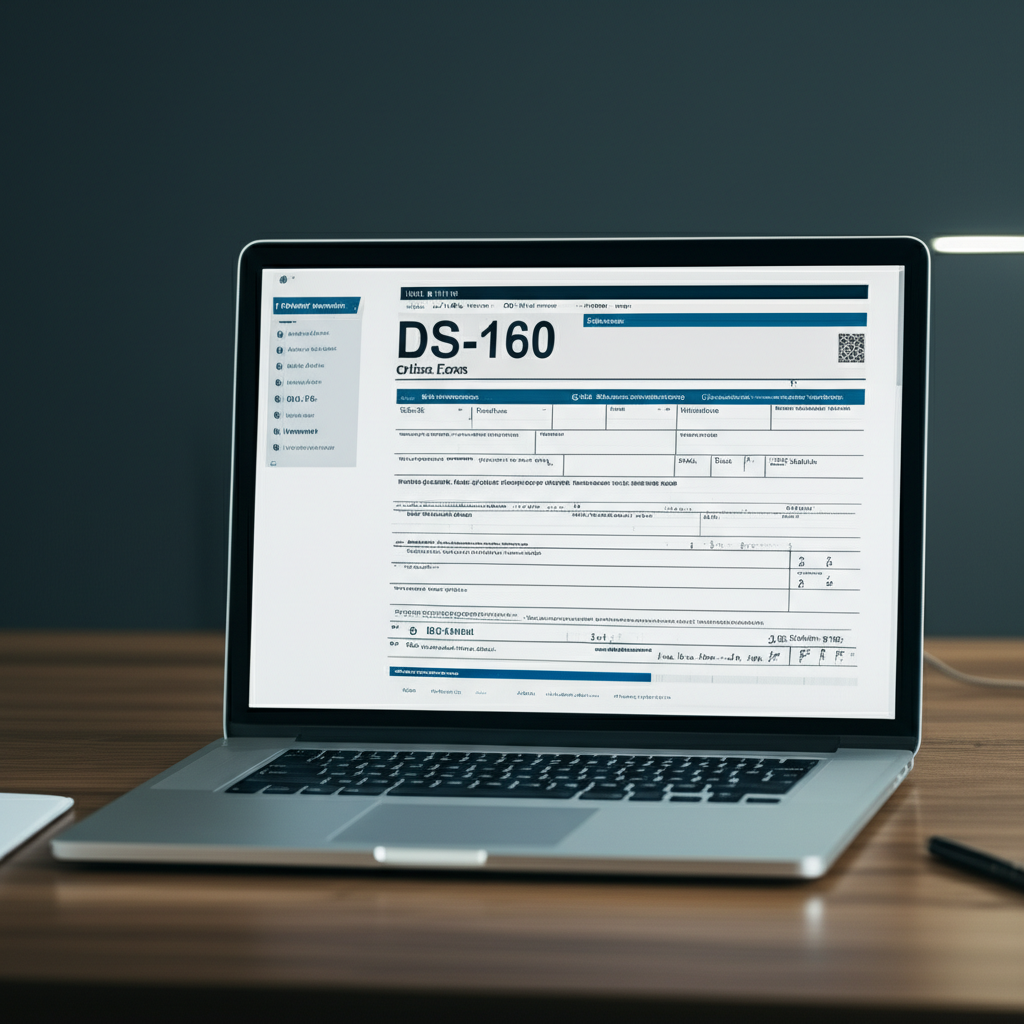
A checklist ensuring accuracy while filling out the DS-160 form for a US visa.
Speaking of which, the most common roadblock isn’t a lie or a major omission—it’s a simple lack of consistency. The DS-160 is the backbone of your visa file, and every piece of information you enter must be 100% accurate and perfectly match your other official documents. Think of your passport, I-20, and DS-160 as three legs of a stool. If one is shorter than the others, the whole thing wobbles. For example, if your passport says “Jayanthi Kumari Bandara” but you casually enter “Jayanthi Bandara” on the DS-160, that discrepancy creates immediate doubt for a consular officer.

Common Pitfalls and How to Sidestep Them

Two sections consistently trip up Sri Lankan applicants: your study plans and your proof of funding. When the form asks about your purpose of travel, a vague answer like “To study” is not enough. Be specific. Mention your university, your major, and why you chose that specific program. Similarly, for funding, simply writing “Family funds” is weak. Your answer should align with the financial documents you will present, which, according to AECC Sri Lanka, typically show between US$10,000 and US$25,000. A better entry would be: “My studies will be funded by my father’s business income and family savings, as documented in the attached bank statements.” This shows foresight and preparation. Before you even begin the application on the Consular Electronic Application Center website, follow this simple preparation method:
  • Gather Everything First: Have your passport, Form I-20, and financial documents physically in front of you. This prevents you from entering information from memory.
  • Review and Re-Review: After completing the form but before submitting, read every single answer aloud. This helps catch typos and grammatical errors your eyes might otherwise skim over.
  • Get a Second Opinion: Ask a trusted teacher, parent, or friend to proofread your application. A fresh pair of eyes is your best defense against small but significant mistakes.

3: Proving Financial Stability - The Biggest Hurdle

You’ve done it. You have the acceptance letter and your Form I-20 in hand. The excitement is real, but then you see that estimated cost of attendance. A wave of anxiety hits. How do you possibly prove to a stranger in a 3-minute interview that you or your family can afford this? This is where many promising Sri Lankan students stumble, not because they lack the funds, but because they fail to present them convincingly.
Organized financial documents required to prove financial stability for an F-1 visa.
The U.S. government needs assurance that you can support yourself financially without resorting to unauthorized work. This means you must show liquid assets sufficient to cover the full first year's cost of attendance as stated on your I-20. This can be a combination of personal savings, an approved educational loan from a recognized Sri Lankan bank, scholarships, or sponsorship from your immediate family. It’s a straightforward requirement on paper. But wait — there's more to consider. The most common mistake we see is what consular officers call 'funds parking'. Imagine this scenario: two weeks before your visa interview, a well-meaning uncle deposits a large sum, say US$20,000, into your bank account to help you meet the requirement. To an officer reviewing your documents, this is a major red flag. It suggests the money isn't genuinely available for your education and might be withdrawn right after the interview. This single action can cast serious doubt on your entire application.

Building a Credible Financial Profile

To avoid this pitfall, you need to present a consistent and believable financial story. Provide bank statements for the last six months, not just the most recent one. A stable, gradually built-up balance is far more persuasive than a sudden, unexplained windfall. If you have a sponsor, such as your parents, they must submit a formal affidavit of support. This isn't just a simple letter; it should be accompanied by their six-month bank statements, a letter from their employer confirming their salary and position, and documents like your birth certificate to prove the relationship. A clear, documented history of funds tells a story of genuine preparation and intent.

4: The Visa Interview: Demonstrating Non-Immigrant Intent

You’ve done it all. You secured admission, received your Form I-20, paid the US$350 SEVIS I-901 fee, and meticulously filled out the DS-160. Now, only a short, ten-minute interview at the U.S. Embassy in Sri Lanka stands between you and your goal. For many students, this is the most stressful part of the entire process. It can feel like your entire future rests on a few questions from a consular officer, and in many ways, it does. What they are looking for isn't just a confirmation of your academic plans, but something much more fundamental.
A Sri Lankan student confidently answering questions at the F-1 visa interview.
Building on that foundation of a perfect application, the interview is your chance to prove the single most important eligibility criterion: non-immigrant intent. In simple terms, you must convince the officer that you plan to return to Sri Lanka after completing your studies. Under U.S. law, the officer must assume you intend to immigrate permanently unless you prove otherwise. Your job is to present a clear, credible, and compelling case for your return.

Articulating Your 'Ties to Home'

Your proof lies in your "ties to home"—the significant professional, financial, and family connections that pull you back to Sri Lanka. You need to be prepared to discuss these specifically. Think of them as anchors holding you to your home country. These can include:
  • Family Obligations: Your parents, spouse, or children who are staying behind in Sri Lanka.
  • Property Ownership: Land or a home that you or your immediate family own.
  • A Future Job: A conditional job offer or a clear, logical career path with a specific Sri Lankan company or industry upon your return.
The most common mistake applicants make is giving vague, rehearsed answers. Saying, “I plan to return to serve my country” is a red flag for officers who have heard it thousands of times. Instead, be concrete and personal. Avoid expressing any desire to stay and work in the U.S. after graduation, as this directly contradicts non-immigrant intent. For example, instead of a generic statement, try something specific: "After my Master's in Cybersecurity, I plan to return to my role at Virtusa in Colombo. My manager has already approved a study leave, and my new skills will help me lead their new financial security division." This answer connects your U.S. education directly to a tangible, high-value career waiting for you back home. It's believable because it's detailed.

5: Post-Approval & Common Arrival Mistakes

That moment the consular officer says “Your visa is approved” is pure relief. You’ve done it. After months of applications, gathering financial documents, and a stressful interview, the biggest hurdle is behind you. But in the rush of excitement, many students from Sri Lanka make simple, last-minute errors that can cause serious problems, even turning them back at the U.S. airport. The journey isn’t quite over until you’re on campus.
A student with an approved F-1 visa ready to travel from Sri Lanka to the USA.

From Embassy to Airport: Your Essential Carry-On

A few days after your interview, you will receive your passport with a new F-1 visa stamp inside. Check it immediately to ensure your name, date of birth, and other details are correct. This visa, along with your original Form I-20, is your golden ticket. These documents are irreplaceable on your travel day. Never pack them in your checked luggage. If your suitcase is delayed or lost, you will be unable to present them to U.S. immigration officials. Your carry-on bag must contain:
  • Your passport with the F-1 visa stamp.
  • The original, signed Form I-20 issued by your university.
  • Proof of your SEVIS I-901 fee payment (the receipt).
Having these physically with you ensures you can face the final check at the U.S. port of entry with confidence.

The 30-Day Rule: A Costly Arrival Mistake

One of the most frequent and heartbreaking errors is arriving too early. Imagine the exhaustion and excitement of landing at your destination, only to be told by a U.S. Customs and Border Protection (CBP) officer that you are 35 days early and cannot enter the country. It happens. Federal regulations are strict: you are not permitted to enter the United States more than 30 days before the program start date listed on your Form I-20. To avoid this, find the "Program Start/End Dates" section on your I-20. Just below it, you will see an "Earliest Admission Date." This is the first day you are legally allowed to enter the U.S. Book your flight to land on or after this specific date. When you arrive, the CBP officer will ask a few simple questions about your school and your study plans. Have your documents ready, answer clearly, and you will be welcomed into the country to begin your studies.

From Applicant to Approved: Your Final Step

The fear of a visa denial after months of hard work is a heavy weight for many Sri Lankan students. It's easy to get lost in the details of financial documents and interview questions, worrying about a single slip-up. The key to transforming this anxiety into confidence lies in one core principle: building a consistent and believable narrative. More than just paperwork, your application is the story of your ambition in the U.S. and your definite plan to return to Sri Lanka. When every document and every answer supports this single, powerful story, your application becomes compelling. Feeling overwhelmed? Ensure your application is perfect. Schedule a one-on-one consultation with our F-1 visa experts today!

Frequently Asked Questions

How much bank balance is required for an F-1 visa from Sri Lanka?

There is no exact amount. You must prove you have liquid funds to cover at least the first year of expenses listed on your I-20 form. This includes tuition, living expenses, and fees. It is recommended to show funds for the entire duration of the course if possible.

What are considered strong ties to Sri Lanka for a student visa?

Strong ties are aspects of your life that would compel you to return to Sri Lanka after your studies. These include family (parents, spouse, children), property ownership, a confirmed job offer upon your return, and a clear career plan that requires you to be in Sri Lanka.

Can I work in the USA on an F-1 visa?

F-1 visa holders have limited work privileges. You can typically work on-campus for up to 20 hours per week during the semester. Off-campus work requires special authorization (CPT or OPT) and is strictly regulated. You cannot rely on working in the US to fund your studies.

Related Articles