Have you ever scrolled through LinkedIn, found the perfect software engineering role at a Silicon Valley company, and then felt your heart sink at the words "must be eligible to work in the US"? You're a talented professional from Sri Lanka with the skills to compete globally. Yet, the path to H-1B...
A
Admin
Jan 12, 2026
10 views
Share:
Have you ever scrolled through LinkedIn, found the perfect software engineering role at a Silicon Valley company, and then felt your heart sink at the words "must be eligible to work in the US"? You're a talented professional from Sri Lanka with the skills to compete globally. Yet, the path to H-1B visa sponsorship often feels like an impossible maze, a game of chance dictated by a lottery system that ignores your qualifications.
This uncertainty is a shared experience. But what if you could move beyond just hoping for the best? Securing an H-1B isn't purely about luck; it's about a well-executed strategy. It involves identifying companies that consistently sponsor, timing your applications to align with the USCIS fiscal year, and preparing documentation that proves your "specialty occupation" status without a doubt.
This article provides that strategy. We will outline the exact steps you can take, from using public data to find sponsor-friendly employers to preparing for the consular interview in Colombo. You will learn how to position yourself as an ideal candidate long before the application window opens, turning a game of chance into a calculated career move.
Understanding the H-1B Visa: The Basics for Sri Lankans
You’ve seen the job postings from US tech companies. You have the skills, the four-year degree from a respected university, and the drive to compete on a global stage. Yet, a complex and often frustrating barrier stands in the way: the US visa system. For many Sri Lankan tech professionals, the term “H-1B” is a source of both hope and confusion. So what exactly is this visa, and why is it the primary pathway for so many?
The Two Sides of H-1B Eligibility
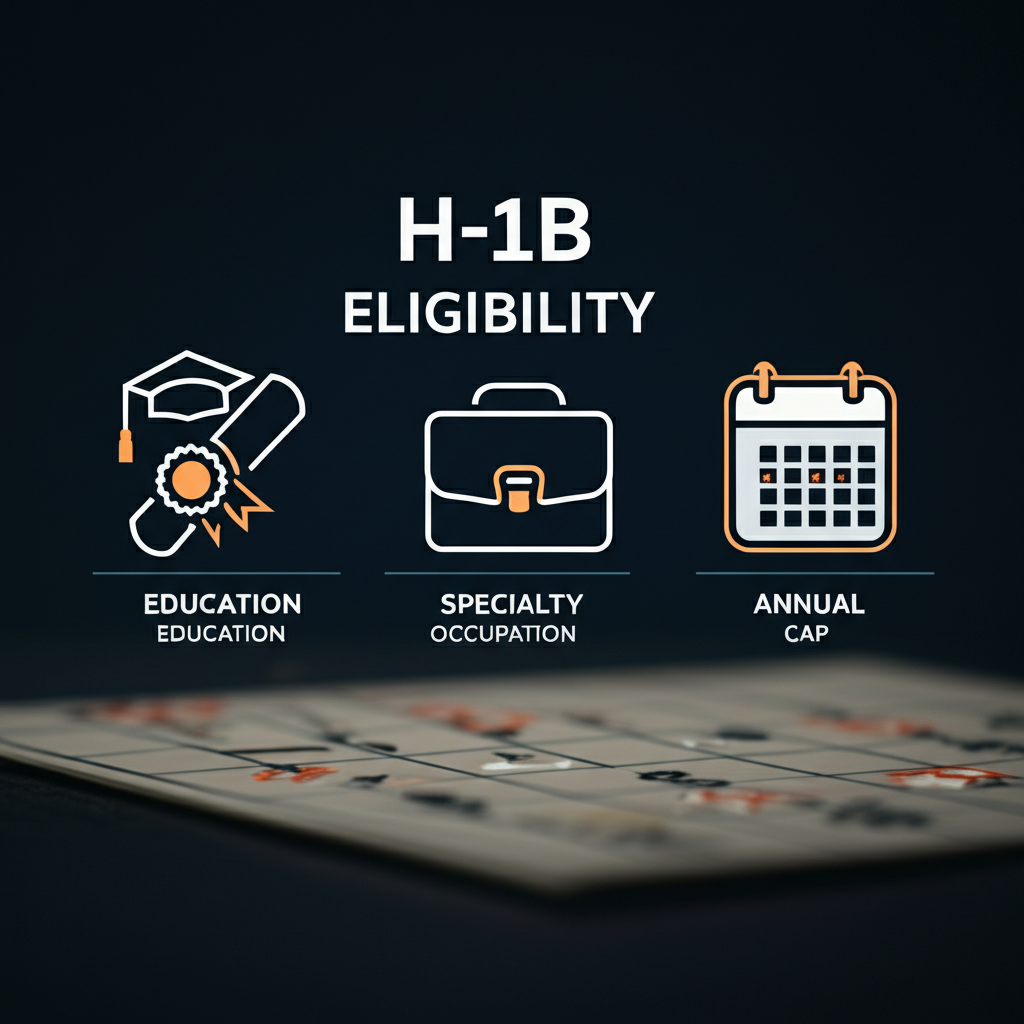
At its core, the H-1B is a non-immigrant visa for foreign professionals working in a specialty occupation. Think of a specialty occupation as any role that requires, at a minimum, a bachelor’s degree in a specific field. Your software engineering degree directly qualifies you for a software engineering job; that’s the fundamental connection. According to U.S. Citizenship and Immigration Services (USCIS), eligibility rests on two pillars. First, you, the professional, must hold a relevant bachelor’s degree or its equivalent. Second, a U.S. employer must sponsor you for a specific job that requires that degree.
The employer’s role is active, not passive. Before they can even file a petition for you, they must submit a Labor Condition Application (LCA) to the U.S. Department of Labor. This document is their formal promise to pay you the required local wage and ensure your employment won’t negatively impact American workers. It's a critical first step that protects both you and the domestic labor market.
Why It's a Lottery
Here is the challenge. The U.S. government sets an annual cap on new H-1B visas: 65,000, with an additional 20,000 reserved for those holding a U.S. master’s degree or higher. The demand massively outstrips this supply. For example, Anjali, a data scientist from Colombo, might secure a job offer from a company in San Francisco. Her employer would enter her into an electronic registration system in March. Because hundreds of thousands of others are also registered, her chance of being selected is purely based on a random lottery. If her name is drawn, the company can then proceed with the full H-1B petition. This visa typically grants a stay of up to three years, extendable to a total of six.
The H-1B Lottery: A Step-by-Step Timeline
You’ve done the hard work. You’ve networked, interviewed, and finally secured a job offer from a U.S. tech company willing to sponsor you. You can almost picture yourself contributing to a project in Seattle or Boston. Then, your prospective employer mentions the one thing entirely out of your control: the lottery. The feeling can be deflating, knowing that your future rests on a random, computerized draw.
This brings us to something often overlooked—the rigid, time-sensitive nature of the H-1B selection system. Understanding this timeline is the best way to manage your expectations and prepare for what comes next. The entire process, from registration to petition, is a sprint governed by strict deadlines set by U.S. Citizenship and Immigration Services (USCIS).
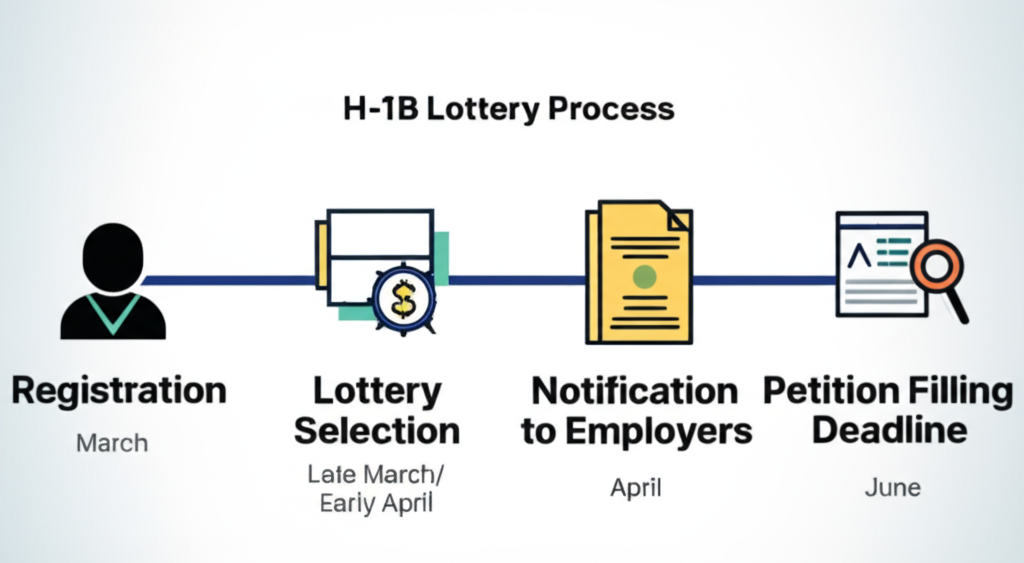
Here is how the H-1B cap season typically unfolds:
Step 1: The Registration Window (Early to Mid-March). For a brief period, usually the first three weeks of March, your employer submits an electronic registration on your behalf. This is a simple online form that requires basic information about you and the company. It’s a low-cost, low-effort first step designed to reduce the paperwork burden from the old system.
Step 2: The Computerized Lottery (Late March). Once the registration window closes, USCIS conducts a random selection. Because demand far exceeds the 85,000 available visas (65,000 for the regular cap and 20,000 for those with a U.S. master's degree or higher), a lottery is necessary. The selection is two-tiered: first, all registrants are entered for the 65,000 slots. Then, unselected registrants with a U.S. master's degree get a second chance for the remaining 20,000 visas.
Step 3: Notification and Filing (April 1 to June 30). By March 31st, your employer will be notified if your registration was selected. If you are chosen, a 90-day window opens, starting April 1st. During this time, your employer’s legal team must prepare and file the comprehensive I-129 petition, complete with the certified Labor Condition Application (LCA) and supporting evidence. Missing this 90-day deadline means forfeiting your spot.
For a Sri Lankan software developer with a bachelor’s degree, your odds depend entirely on the number of registrations that year. With recent years seeing over 750,000 registrants for 85,000 slots, the chances are statistically low. This isn't a reflection of your skills or the company's commitment; it is simply a numbers game. Knowing this allows you to stay grounded and explore parallel options while you await the results.
Finding a Sponsoring Employer in the US Tech Industry
You’ve perfected your resume, built an impressive portfolio, and aced countless technical screenings. Yet, a single question on the application form often feels like a dead end: “Will you now or in the future require sponsorship for employment visa status?” Answering “yes” can feel like sending your application straight into the void. The silence that follows is frustrating, leaving you to wonder if your skills were ever even considered.
Instead of casting a wide net and hoping for the best, a targeted strategy is far more effective. Your first move should be to identify companies with a documented history of H-1B sponsorship. You can do this by using public resources like the H-1B Employer Data Hub provided by U.S. Citizenship and Immigration Services (USCIS). This tool allows you to search for employers who have previously filed petitions, giving you a ready-made list of companies that are already familiar with the process. Look for companies that have filed for roles similar to yours, like "Software Engineer" or "Data Scientist."
Strategic Networking and Application Tailoring
With a target list in hand, your next step is intelligent networking. Use LinkedIn to find Sri Lankan professionals or alumni from your university who are currently working at these companies. A personalized connection request can make all the difference. For instance, a message like, “Hello [Name], I'm a fellow University of Moratuwa graduate specializing in machine learning. I was really impressed by your team's work on [specific project] and would appreciate any insights on your experience at [Company Name]” is more likely to get a response than a simple request for a job.
But wait — there's more to consider. When you do apply, tailor your resume to highlight skills that are in high demand in the US tech market, such as cloud computing certifications (AWS, Azure) or experience with specific enterprise software. Finally, be upfront about your need for sponsorship. While it might feel counterintuitive, disclosing this early on respects the recruiter’s time and ensures you’re only engaging with employers who have the capacity and willingness to sponsor. It filters out the "no's" quickly, letting you focus your energy where it counts.
The Petition and Consular Interview Process in Colombo
The email arrives: "USCIS has selected your registration..." The initial rush of excitement is real, but it's quickly followed by a wave of uncertainty. You’ve won the lottery, but the race isn't over. This next phase—the formal petition and the visa interview—can feel like a mountain of paperwork and pressure. Many talented Sri Lankan professionals get overwhelmed right here, unsure of what their employer needs to do versus what they are responsible for.
Here's what really matters though. The process now splits into two distinct paths: your employer’s legal filing in the U.S. and your personal preparation for the interview in Colombo. Understanding both is the key to getting that visa stamp in your passport.
The Employer's Petition: Form I-129
First, your sponsoring company takes the lead. Their immigration attorney will file a certified Labor Condition Application (LCA) with the U.S. Department of Labor. This document attests that your salary meets the required wage for your role and location, and that your employment won’t negatively impact U.S. workers. Once the LCA is certified, your employer files the main petition, Form I-129, with U.S. Citizenship and Immigration Services (USCIS). This is the comprehensive package that proves the job is a "specialty occupation" and you are qualified for it. You will support this by providing them with documents like your degree certificate, academic transcripts, and letters verifying your past work experience.
Your Consular Interview in Colombo
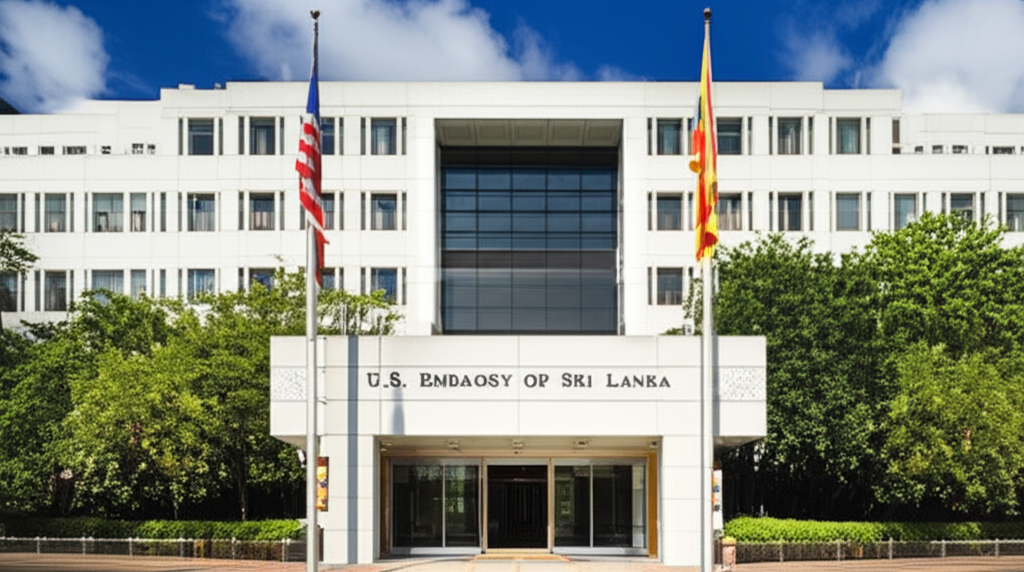
Once USCIS approves the I-129 petition, you receive the treasured Form I-797 Approval Notice. Now, the focus shifts entirely to you. You will complete the DS-160 online visa application, pay the fee, and schedule your interview at the U.S. Embassy on Galle Road. Be prepared to present a clear, organized file with:
Your valid passport and the DS-160 confirmation page.
The original I-797 Approval Notice.
Proof of your educational qualifications and past employment.
A copy of the H-1B petition filed by your employer.
During the interview, the consular officer’s goal is to verify the facts. Expect direct questions like, "Describe the project you will be working on as a Data Scientist," or "Why does this specific role require a bachelor's degree in Statistics?" They are confirming that you are qualified and that the job offer is legitimate. Your confidence and ability to clearly explain your role and qualifications will make all the difference.
Beyond the H-1B: Alternatives and Long-Term Planning
The email arrives. You scan it, heart pounding, only to read the familiar, disappointing words: “was not selected.” The H-1B lottery can feel like a game of chance, leaving your career ambitions in the hands of a random algorithm. It’s a deeply frustrating experience, but it is not the end of the road. A strategic professional thinks beyond a single application and builds a multi-pronged plan.
Exploring Other U.S. Avenues
If the lottery doesn't go your way, several other U.S. visa categories exist that are not subject to the same annual cap. Your eligibility depends entirely on your specific background and employment situation.
The L-1 Visa (Intracompany Transferee): This is a powerful option if you work for a multinational company with offices in both Sri Lanka and the U.S. To qualify, you must have worked for the company abroad for at least one continuous year in the last three years in a managerial (L-1A) or specialized knowledge (L-1B) capacity. For instance, a senior data scientist at a Colombo-based subsidiary of a U.S. firm could be transferred directly to the American headquarters on an L-1B, bypassing the H-1B lottery completely.
The O-1 Visa (Extraordinary Ability): This visa is for individuals at the absolute top of their field. The standard is high, requiring evidence of major awards, published articles in professional journals, or proof of a high salary and critical role in a distinguished organization. It's a demanding path, but for a tech professional with a significant public profile or patented work, it's a direct route to working in the U.S.
The Long Game: From H-1B to Green Card
Securing an H-1B is often just the first step. The H-1B is a "dual intent" visa, which means you can legally pursue permanent residency (a Green Card) while in the U.S. on this status. Most tech professionals achieve this through employer sponsorship via the PERM labor certification process. Your employer essentially proves to the Department of Labor that there are no qualified U.S. workers available for your position. This process is complex and can take years, but it’s the established pathway to making the U.S. your permanent home. Importantly, once your Green Card application reaches a certain stage, you can extend your H-1B status beyond the standard six-year limit, providing stability during the wait.
Ultimately, your international career is a marathon. Whether it's through an alternative visa, a parallel application to a country like Canada, or the steady pursuit of a Green Card, persistence and continuous professional growth are your greatest assets.
Turning Ambition into Action
Watching your global career goals hinge on the uncertainty of the H-1B lottery can be incredibly disheartening. It’s easy to feel that your skills and dedication are lost in a complex system. But your journey doesn’t have to be defined by chance.
The key is shifting from a passive applicant to a proactive strategist. Your most powerful advantage lies in building an undeniable case for your expertise long before any deadlines. This deliberate preparation transforms your application from a mere entry into a compelling professional profile that commands attention.
Begin your journey by researching potential employers and connecting with an experienced immigration attorney to ensure your application is as strong as possible.
Frequently Asked Questions
What are my chances of being selected in the H-1B lottery?
The chances vary significantly each year based on the number of registrations received and the 85,000 available visas. In recent years, the selection rate has been low, often between 10-25%. It's a game of chance, so it's wise to have backup plans.
Can I apply for the H-1B visa myself from Sri Lanka?
No, the H-1B visa is employer-sponsored. A U.S. company must file the petition on your behalf. Your first step is to secure a job offer from a company willing to sponsor you.
Does the Master's cap improve my chances?
Yes. The first 65,000 visas are selected from all eligible registrations. A second lottery for an additional 20,000 visas is then conducted exclusively for those holding a U.S. Master's degree or higher, effectively giving them a second chance at selection.